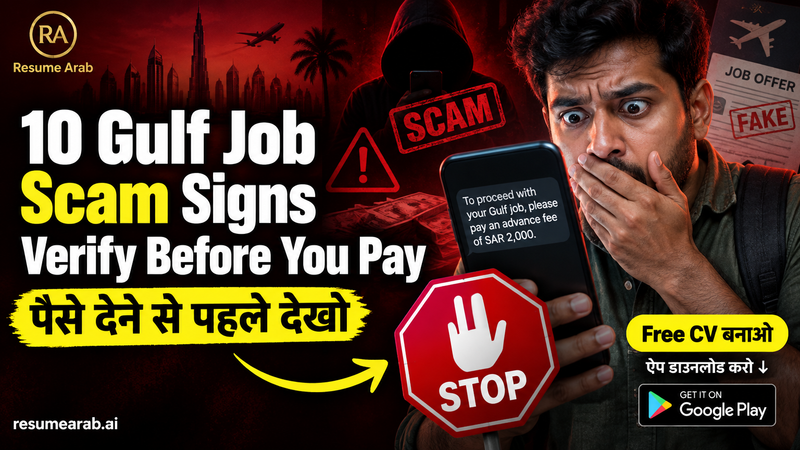
Why fake Gulf offers keep working — and how to shut them down fast
Every week I see the same pattern. A worker from Kerala, Bihar, or Dhaka gets a WhatsApp message: "Urgent requirement in Dubai, salary 4,500 dirhams, visa ready, send 25,000 rupees." He pays. The visa never comes. The number goes dead. By then the agent has moved on to the next group.
The scam works because it copies real hiring language. Real Gulf recruiters do ask for documents. Real employers do arrange medical tests. Real visas do need clearance. The fake offer hides inside that ordinary process, so you cannot tell it apart unless you know exactly which step is wrong.
That is what this guide is for. I have worked GCC hiring for over 12 years. Below are the ten signs I would check before you pay a single rupee, plus the official verification steps most articles skip: MOHRE and Qiwa contract checks, GAMCA medical rules, eMigrate clearance, trade tests, and country-by-country work permit rules.
Before you apply anywhere, put your details into a clean CV you control. Build your free Gulf CV in 2 minutes — then you always have a document to compare against whatever the "agent" sends you.
Sign 1: The salary is too good to be true
A helper job in Kuwait offered at 900 dinars. A driver post in Qatar at 8,000 riyals. A welder in Saudi at 12,000 riyals with "no experience needed." These numbers are bait.
Here is the check that matters. Gulf salaries follow trade and nationality patterns that repeat across companies. If an offer sits far above the normal band for that job, ask why in writing. A real employer will explain allowances, shift pay, or a hardship premium. A scammer will get angry or vanish.
Qatar sets a floor, not a ceiling: the non-discriminatory minimum wage of QAR 1,000 per month, plus accommodation and food allowances if the employer does not provide them, took effect in March 2021 (Qatar Ministry of Labour). That figure tells you the legal minimum. It does not tell you a driver earns 8,000 riyals. Anyone quoting fantasy pay is testing whether you know the market.
Use our Gulf salary check to see realistic bands before you reply to any offer. If the number is double the band, treat the message as hostile until proven otherwise.
Sign 2: They ask you to pay — visa fee, medical fee, "processing"
This is the single clearest red flag. A genuine employer pays for your work visa and permit. The cost sits with the company, not with you.
The advance-fee trick comes in many shapes:
- "Visa stamping fee: 15,000 rupees, refundable after joining."
- "Medical test booking: pay now to reserve your GAMCA slot."
- "Police clearance processing charge."
- "Agent commission, half now, half on arrival."
- A UPI ID, a personal bank account, or a Western Union name that is not a company.
India's Ministry of External Affairs advises emigrant workers to verify recruiting agents through official government channels before paying any recruitment fee (MEA). That sentence is the whole rule. Verify first. Pay nothing until the agent and the employer both check out.
If someone sends you a personal account number or a UPI handle for a "company visa," stop. Companies pay through company channels and issue receipts with a registration number. A WhatsApp message with a phone number and an amount is not a receipt.
Sign 3: No formal interview, or an "interview" that is only a chat
Real hiring has a shape. There is a screening call, a technical conversation, often a trade test, then an offer. A scam often skips straight from "we saw your CV" to "you are selected."
Watch for these:
- Selection within hours, with no questions about your skills.
- An interview on a personal WhatsApp number, no video, no company email.
- No one asks for your passport copy, experience letters, or references — because they do not need them. They only need your money.
- The "HR manager" cannot describe the factory, the site, the shift pattern, or who you will report to.
Ask three specific questions: What is the exact job title and department? Who is my direct supervisor? What are the daily duties and shift timings? A real hiring manager answers in detail. A scammer gives generic replies or changes the subject.
For skilled trades, a proper employer will also test you. Welders get a practical test — usually 6G pipe or structural plate depending on the site. Electricians get fault-finding and panel work. Technicians get equipment-specific questions. If nobody tests your hands, the "job" is probably not a job.
Sign 4: Free email domain and no company website or address
A real company writes from a company domain: name@companyname.com. Scammers use Gmail, Yahoo, Outlook, or a domain registered two weeks ago that copies a real brand with an extra letter.
Do this check in five minutes:
- Look at the email address after the @ symbol. Does it match the company's official website exactly?
- Open the company website. Is there a physical address, a landline, and a registration or licence number?
- Search the company name plus the country's labour authority. Does the employer appear as a licensed entity?
- Call the landline from the website — not the number in the email — and ask for HR.
If the domain is a free provider, or the website has no address, treat it as unverified. A legitimate Gulf employer has a trade licence, an office, and a labour registration. Those leave traces.
Sign 5: Poor grammar, rushed messages, and pressure tactics
Scam messages share a style. Capital letters. "URGENT!!!" "LIMITED SLOTS." Bad grammar. Copy-pasted text sent to dozens of numbers. A demand to decide today because "the visa batch closes tomorrow."
Urgency is a tool. It stops you from checking. Real employers do have deadlines, but they put them in a proper offer letter with a joining date, not in a WhatsApp countdown.
Slow down on purpose. Ask for the offer in writing on company letterhead, with the job title, salary breakdown, allowances, contract duration, probation, and notice period. Then read it twice. A scammer cannot produce a clean written offer because a written offer can be checked.
Sign 6: The offer letter looks wrong — fake letterheads and missing details
A fake offer letter often has a logo pulled from the internet, a signature that is an image, no reference number, and no address. Sometimes the letterhead belongs to a real company that has never heard of you.
Compare the offer against the contract. In Saudi Arabia, private-sector contracts must be in writing under the Labour Law issued by Royal Decree No. M/51 in 2005 (Saudi HRSD). In Qatar, employment contracts must be in writing and registered with the Ministry of Labour under Law No. 14 of 2004 (Qatar Ministry of Labour). A legitimate Gulf employer knows these rules because they follow them every day.
Your offer letter should state:
- Employer's full legal name and address
- Your job title and department
- Basic salary, allowances, and payment method
- Contract duration and probation period
- Working hours, weekly rest, annual leave
- Accommodation and transport arrangements
- Who pays for the visa, medical, and ticket
If any of these are missing, ask for a corrected letter. If the answer is "this is standard, just sign," walk away.
Sign 7: The contract cannot be verified with the labour authority
This is where most articles stop. It is also where you win.
UAE: Federal Decree-Law No. 33 of 2021 came into force on 2 February 2022 and governs private-sector employment, including recruitment and contract rules (MOHRE). Your offer should match the contract registered with MOHRE. If the employer refuses to show the registered version, that is a problem.
Saudi Arabia: Qiwa lets employees view and authenticate their employment contracts electronically, and private-sector contracts must be documented through the platform (Qiwa). Ask for your Qiwa contract before you travel. If the employer says "Qiwa is later, after arrival," do not board the flight.
Kuwait: Law No. 6 of 2010 regulates private-sector employment, and work permits are issued by the Public Authority for Manpower (PAM).
Bahrain: Labour Law No. 36 of 2012 governs private-sector employment, and work permits come from the Labour Market Regulatory Authority (LMRA).
Oman: Labour Law Royal Decree No. 35/2003 requires employers to obtain work permits from the Ministry of Labour (Oman MoL).
Qatar: Contracts must be registered with the Ministry of Labour, as noted above.
A scammer cannot produce a registered contract because there is no employer behind the offer. Ask for the registration reference. If it never arrives, you have your answer.
Sign 8: Medical tests and GAMCA — the fee trap
GCC-bound workers generally need a medical fitness certificate from a GAMCA-approved clinic. Applicants should verify the clinic on GAMCA's official list before paying (GAMCA).
The scam version works like this: the agent names a "GAMCA centre" that is not on the list, or asks you to pay a booking fee to a personal account. You pay, the test never happens, and the agent blames "embassy delays."
Your protection is simple. Open the official GAMCA list yourself. Confirm the clinic is approved. Pay the clinic directly at the counter, and keep the receipt. Never pay a middleman for a medical slot.
Saudi-bound workers may also hear about Wafid for medical checks. The principle is the same: confirm the centre through the official channel, pay the centre, keep every paper.
Sign 9: No eMigrate clearance or ECR check for Indian workers
If you hold an ECR passport, India's Emigration Act, 1983 requires emigration clearance before you take up employment in 18 ECR countries, including the UAE, Saudi Arabia, Qatar, Kuwait, Oman and Bahrain (eMigrate).
This is a legal step, not a formality. A legitimate employer or registered recruiting agent will handle it through the official eMigrate system. A scammer will tell you to "travel on a visit visa and convert later." That route leaves you without legal protection and often without the job.
Before you fly, confirm:
- Your agent is registered and can be verified through official channels (MEA).
- Your emigration clearance is done through eMigrate.
- Your job offer, contract, and visa all name the same employer.
If any of these is missing, do not travel. A visit visa is not a work visa. Converting later is not guaranteed, and you carry the risk.
Sign 10: Requests for your passport, bank details, or OTPs
No real employer needs your bank password, your OTP, or your original passport before a contract is signed and registered. They need copies of documents at defined stages, and they tell you why.
Never send:
- OTPs or bank login details
- A photo of your debit or credit card
- Your original passport by courier to an unverified address
- Signed blank papers
Keep your passport with you. Share clear scans only after you have verified the employer and the contract. If someone insists on your original passport "for visa processing" before any registered contract exists, refuse.
Country-by-country work permit rules you should know
Each Gulf state runs its own permit system. A real offer fits the local rule. A fake one ignores it.
| Country | Key rule to check | Official source |
|---|---|---|
| UAE | Private-sector employment governed by Federal Decree-Law No. 33 of 2021 | MOHRE |
| Saudi Arabia | Written contracts; Qiwa documentation; Wage Protection System since 2013 | HRSD, Qiwa |
| Qatar | Written contract registered with Ministry of Labour; minimum wage QAR 1,000 plus allowances | Qatar MoL |
| Kuwait | Law No. 6 of 2010; permits via Public Authority for Manpower | PAM |
| Bahrain | Law No. 36 of 2012; permits via LMRA | LMRA |
| Oman | Royal Decree No. 35/2003; permits via Ministry of Labour | Oman MoL |
Saudi Arabia's Wage Protection System, introduced in 2013, requires private-sector employers to pay wages through approved local banks (HRSD). Ask how your salary will be paid. "Cash in hand" is a warning sign, not a convenience.
Before any interview, run your documents through our Visa checklist so you know exactly what a real employer should request and when.
A printable scam checklist — use it before you pay or fly
Copy this list. Tick every line before you commit money or travel.
- Employer's full legal name and address confirmed on their official website
- Email comes from the company domain, not Gmail or Yahoo
- Landline called from the website, HR spoken to directly
- Job title, duties, and supervisor explained in detail
- Trade test or technical interview completed
- Written offer letter with salary breakdown, allowances, and contract terms
- Contract registered with the national labour authority (MOHRE, Qiwa, MoL, PAM, LMRA)
- GAMCA or Wafid clinic confirmed on the official list
- Medical fee paid directly to the clinic, receipt kept
- Recruiting agent verified through official government channels
- eMigrate emigration clearance completed (ECR passport holders)
- No payment made to a personal account, UPI ID, or unverified agent
- Passport and bank details not shared beyond verified, necessary steps
- Visa type is a work visa, not a visit visa
If even three boxes are unticked, pause. A real employer will wait for you to finish checking. A scammer will push you to skip.
How to report a Gulf job scam
Report early. Reports protect the next worker.
- India: Report to your local police cybercrime unit and to the Ministry of External Affairs through official channels (MEA). For emigration-related fraud, use the eMigrate system (eMigrate).
- UAE: Report to the labour authority and police. MOHRE handles private-sector employment complaints (MOHRE).
- Saudi Arabia: Report to the Ministry of Human Resources and Social Development (HRSD).
- Qatar: Report to the Ministry of Labour (Qatar MoL).
Keep everything: screenshots, phone numbers, bank details, receipts, and the offer letter. A report with evidence moves faster than a report with a story.
When you apply for real roles, use Verified Gulf jobs so you start from employers that can be checked.
FAQ
How can I check if a Gulf job offer is real?
Verify four things: the employer's legal name and trade licence, the email domain, the registered contract with the national labour authority, and the recruiting agent's registration. Call the company landline from its official website. If any of these cannot be confirmed, treat the offer as unverified.
Do I need to pay for a Gulf work visa?
No. A genuine employer pays for the work visa and permit. India's Ministry of External Affairs advises workers to verify recruiting agents through official channels before paying any recruitment fee (MEA). Payments to personal accounts or UPI IDs for a "visa" are a scam pattern.
What documents should a legitimate Gulf employer provide?
A written offer letter with the employer's legal name and address, job title, salary breakdown, allowances, contract duration, probation, working hours, leave, accommodation terms, and who pays for the visa, medical, and ticket. For Saudi Arabia, the contract should be documented through Qiwa (Qiwa). For Qatar, it must be registered with the Ministry of Labour (Qatar MoL).
How do I verify a recruiting agent for Gulf jobs?
Check the agent's registration through official government channels before paying anything (MEA). For Indian workers, confirm emigration clearance through eMigrate (eMigrate). An unregistered agent cannot legally process your Gulf employment.
Is a Gulf job offer asking for a medical test fee a scam?
Not always — but the payment route matters. Confirm the clinic on GAMCA's official list (GAMCA), pay the clinic directly, and keep the receipt. A demand to send a medical fee to a personal account or agent is a scam pattern.
How can I report a Gulf job scam in India?
Report to your local police cybercrime unit and to the Ministry of External Affairs through official channels (MEA). For emigration fraud, use eMigrate (eMigrate). Keep screenshots, receipts, bank details, and the offer letter.
What is GAMCA medical and is it required for a Gulf work visa?
GAMCA is the approved medical examination system for many GCC-bound workers. Verify the clinic on the official GAMCA list before paying (GAMCA). Requirements vary by country and employer, so confirm with the embassy or the employer's instructions.
What is eMigrate emigration clearance?
Under India's Emigration Act, 1983, ECR passport holders need emigration clearance before employment in 18 ECR countries, including the UAE, Saudi Arabia, Qatar, Kuwait, Oman and Bahrain (eMigrate). It is a legal requirement, not an optional step.
Can I verify my UAE employment contract with MOHRE?
Yes. UAE private-sector employment is governed by Federal Decree-Law No. 33 of 2021 (MOHRE). Your offer should match the contract registered with MOHRE. Ask for the registered version before you travel.
How do I check my Saudi employment contract on Qiwa?
Qiwa lets employees view and authenticate their employment contracts electronically, and private-sector contracts must be documented through the platform (Qiwa). Ask for your Qiwa contract before you fly. If the employer delays it until after arrival, do not travel.
Final word: verify, then move
A real Gulf job survives checking. A fake one collapses the moment you ask for a registered contract, an official clinic, or a verified agent. You do not need to be an expert in labour law. You need a checklist and the patience to use it.
Get your CV ready first, so you apply from strength: Build your free Gulf CV in 2 minutes. Then verify every offer against the official links above. And keep the Resume Arab app on your phone so the checklist travels with you.