Spot the salary trap first
A fake Gulf job offer usually starts with a number that sounds too good. A driver offered double the normal pay. A helper promised a big "joining bonus" before the visa is even stamped. A hotel job with free flights, free food, free housing and a salary that no real employer in that trade pays.
Real employers in the Gulf pay by trade, by experience and by company size. They do not double a salary because you replied fast on WhatsApp.
Before you send any document, build a clean CV that shows your real trade, your real years and your real skills. Build your free Gulf CV in 2 minutes. A proper CV makes fake recruiters back off, because they cannot match their fake offer to a real work history.
I am Salman. I have worked in GCC hiring for more than 12 years, on the agency side and inside company HR. I have seen the same scam pattern repeat: a fast offer, a small payment, then a bigger payment, then silence. This article gives you the checks I would run myself, in the order I would run them.
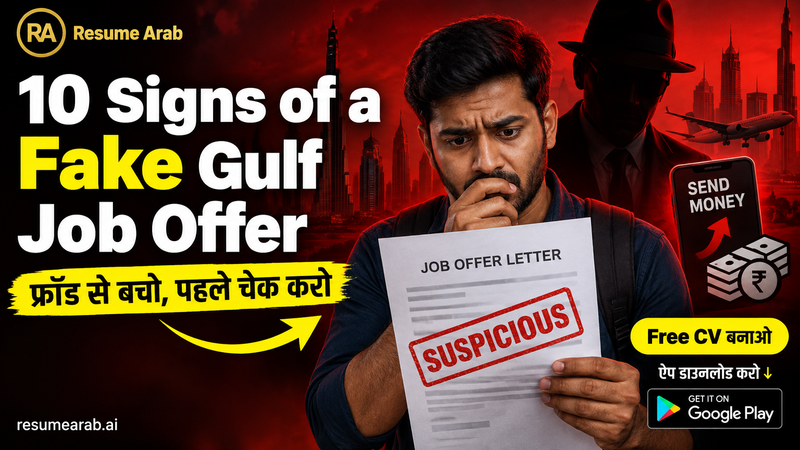
The 10 signs of a fake gulf job offer
Here is the short list. Each sign is explained in its own section below.
- Salary is far above the market for that trade.
- They ask for money before you have a written offer.
- They ask for a "visa fee" or "stamping charge".
- They ask for your passport, bank details or OTPs too early.
- The email domain does not match the company.
- Poor grammar, wrong company name, copy-paste text.
- No formal interview, or an "interview" that is only a chat.
- The job description is vague about duties and location.
- High-pressure urgency: "pay today or the seat is gone".
- WhatsApp-only contact and an agent you cannot verify.
Now the detail. Read each one and check your own offer against it.
Sign 1: The salary is too good for the trade
A fake offer is built on greed, not on the job. The scammer does not know your trade. He knows what makes people reply fast.
Real signals of a genuine Gulf salary:
- It sits close to what other workers in the same trade and same city earn.
- Allowances are listed separately: housing, transport, food, phone.
- Overtime is described in the contract, not promised verbally.
- The pay date is stated, and salary is paid through a bank.
Fake signals:
- "Salary negotiable, up to X" with X far above the trade.
- A big "bonus" promised before you travel.
- Free everything, with no company name you can check.
- Pay quoted in cash, "on arrival".
Use our Gulf salary check to see what your trade normally pays before you believe any number. If your offer is far above that range and the employer cannot explain why, stop.
Sign 2: They ask for money before any written offer
This is the single strongest sign. A real employer or a licensed agency does not need your money to prove you have a job.
The correct order is always:
- You apply.
- You are shortlisted.
- You attend a real interview.
- You receive a written offer with the company name, job title, salary, allowances, location and start date.
- Only then do you discuss any cost, and only with a licensed agency.
If money is asked before step 4, treat the offer as fake until proven otherwise.
For Indian workers, the law is clear on this. Emigration clearance is handled through the government system, not through a random agent's personal account. India's Emigration Act, 1983 requires ECR passport holders to obtain emigration clearance before employment in 18 ECR countries, including UAE, Saudi Arabia, Qatar, Kuwait, Oman and Bahrain (eMigrate). The official portal is where you check your own status, not a WhatsApp screenshot.
Sign 3: The "visa fee" or "stamping charge" demand
A visa fee is a real cost, but it is the employer's cost in a proper Gulf hire. When a recruiter asks you to pay for "visa stamping", "labour approval", "medical clearance" or "insurance", ask one question: why is the employer not paying?
Common fake lines:
- "Pay the visa fee now, the company will refund it after joining."
- "The embassy needs a deposit from you."
- "Pay for the work permit and we will adjust it in your first salary."
None of these are normal. A genuine employer budgets the visa and work permit as part of hiring. If a company cannot pay for its own work permit, it is not a company you want to join.
Keep every receipt if you have already paid. You will need it for a complaint.
Sign 4: They want your passport, bank details or OTPs too early
Documents are collected at the right stage, not on day one.
Documents a real employer or licensed agency may ask for at shortlisting:
- CV
- Passport copy (photo page)
- Passport-size photo
- Trade certificates or experience letters
- Educational certificates, if the job needs them
Documents and details nobody should ask for before a written offer:
- Your original passport, sent by courier to an individual
- Net banking password or OTP
- Full bank account details with card numbers
- A signed blank paper
- A signed resignation letter for your current job
Passport retention is a serious risk. Never hand your original passport to an agent or a "company representative" who is not a licensed recruiter or your actual employer's HR. If your passport is held, you lose your ability to leave and to complain.
Sign 5: The email domain does not match the company
This check takes two minutes and catches many fakes.
Look at the email address. A real company writes from its own domain, for example hr@companyname.com. A fake writes from a free mail service or a lookalike domain:
- companyname.hr@gmail.com
- hr.companyname@outlook.com
- company-name-hr@yahoo.com
- companyname.co (when the real site is companyname.com)
Also check the reply-to address. Scammers often set the display name to the company but the reply address to a personal inbox.
Then open the company's official website in a separate browser tab. Do not use the link in the email. Find the careers page and the contact number yourself. Call the number from the website, not from the email signature.
Sign 6: Poor grammar, wrong names and copy-paste text
A real HR email has your name, the job title, the location and the next step. A fake email is generic and full of errors.
Red flags in the text:
- "Dear Candidate" or "Dear Applicant" with no name.
- The company name changes in the same email.
- The job title does not match the subject line.
- Mixed fonts, odd spacing, logos that look stretched.
- Sentences copied from another company's website.
- A signature with no phone number, no address and no registration number.
One typo is not proof of a scam. A pattern of errors, wrong names and missing contact details is.
Sign 7: No formal interview, or an "interview" that is only a chat
Every real Gulf hire has some form of interview. It may be a phone call, a video call, a trade test or a face-to-face meeting at a licensed agency. What it will not be is a five-minute WhatsApp chat that ends with "you are selected, pay the visa fee".
What a real interview covers:
- Your actual duties, day to day
- Tools, machines or equipment you have used
- Your shift pattern and site location
- Your notice period and passport validity
- Your expected salary and allowances
- Safety rules and site rules
What a fake interview looks like:
- No questions about your skills
- No interviewer name or job title
- No company introduction
- Instant selection
- Selection before you even send documents
If nobody asked you a single technical question, ask yourself what they are actually hiring you for.
Sign 8: The job description is vague about duties and location
A real offer names the role, the department, the site and the reporting manager. A fake offer keeps everything soft.
Compare these two:
Real: "Heavy vehicle driver, company transport division, based at Jebel Ali depot, reporting to transport supervisor, 6-day week, 10-hour shift, overtime after 8 hours."
Fake: "Driver required for a big company in UAE. Good salary. Free accommodation. Apply fast."
The second one gives you nothing to check. No company, no city, no duties, no contract terms. That is the point. If you cannot describe the job to your family in one sentence, you do not have a real offer.
Sign 9: High-pressure urgency
Scammers create a deadline so you do not have time to check.
Lines to watch for:
- "Only 2 seats left, pay today."
- "The visa window closes tonight."
- "If you do not confirm in one hour, we will give it to someone else."
- "Do not tell anyone about this offer until you join."
Real hiring has timelines, but they are tied to document deadlines and joining dates, not to a countdown on a phone. A company that needs your money in one hour is not a company. It is a scam.
Slow down. A genuine offer survives a two-day check.
Sign 10: WhatsApp-only contact and an unlicensed agent
WhatsApp is normal for quick updates in the Gulf. It is not normal for the entire hiring process.
A real process has:
- A company email address
- A landline or office number
- A licensed agency with a registration number
- A written offer on company letterhead
- A contract you can read before signing
A fake process has:
- A personal WhatsApp number with a foreign profile photo
- Voice notes instead of written terms
- No office address, or an address you cannot verify
- An agent who cannot show a licence
- A demand to move the chat to another app when you ask questions
For Indian workers, you can check a recruiting agent before paying anything. The MEA's eMigrate portal lets Indian workers verify a registered recruiting agent before paying any recruitment fee (MEA eMigrate). Use it. It takes minutes and it has stopped many bad payments.
How to verify the employer in each Gulf country
This is the part most articles skip. Each Gulf country has an official labour system, and you can use it to check whether the employer and the work permit are real.
UAE. Private-sector work permits and contracts run through MOHRE. UAE Federal Decree-Law No. 33 of 2021, effective 2 February 2022, requires a written employment contract for private-sector workers (MOHRE). Salaries must be paid through the Wages Protection System, which requires private-sector wages to be paid through an approved system (MOHRE). If an employer says "we pay cash, no bank", that is a warning.
For domestic work in the UAE, MOHRE licenses Tadbeer centres for domestic-worker recruitment, and direct recruitment of domestic workers is not permitted (MOHRE). If someone offers you a housemaid or driver job "directly from the family", without a Tadbeer centre, question it.
Saudi Arabia. Qiwa is the official platform for documenting private-sector employment contracts (Qiwa). Ask for the contract reference and check it. Saudi Arabia's Wage Protection System requires private-sector salaries to be paid through approved local banks (MHRSD). A Saudi offer with cash salary and no bank details is not a normal Saudi hire.
Qatar. Qatar Labour Law No. 14 of 2004 requires employment contracts to be in writing and registered with the Ministry of Labour (Qatar MOL). Ask for the registered contract, not a PDF from a personal email.
Bahrain. Bahrain's LMRA issues and regulates work permits for foreign workers (LMRA). A work permit you cannot trace to LMRA is a problem.
Kuwait and Oman. Use the same logic: ask for the employer's commercial registration, the work permit reference and the written contract. If the employer cannot give a reference you can check with the labour authority, do not pay.
This is where a proper CV helps you twice. It gets you shortlisted by real employers, and it gives you a paper trail of your real skills. Build your free Gulf CV in 2 minutes and keep a copy of every version you send.
The GAMCA medical test: real step, fake shortcut
A medical test is a normal part of a Gulf work visa. GAMCA medical examinations for GCC work visas are conducted at GCC-approved centres and screen for infectious diseases (GAMCA).
What is normal:
- You are told which approved centre to attend.
- You book through the official channel.
- The test is done at the centre, in person.
- Results go to the approved system.
What is not normal:
- An agent says he will "arrange the medical" without you attending.
- Someone offers a "guaranteed fit" certificate for a fee.
- You are asked to pay a large sum to a personal account for the medical.
- You are sent to a clinic that is not on the approved list.
Do not ask how much a GAMCA test costs from a random agent. Check the official GAMCA channel for the approved centre and the current fee. Any agent who quotes a price far above the official one, or who offers to skip the test, is not helping you.
Trade tests: where fake offers fall apart
A trade test is the moment a fake offer cannot continue. A real employer wants to see your hands, your tools and your safety habits.
Real trade test signals:
- A named test centre, workshop or site.
- A tester with a name and a role.
- Real tasks: welding a joint, wiring a panel, driving a route, cooking a set menu, operating a machine.
- Safety gear provided or required.
- Results in writing.
Fake trade test signals:
- "No test needed, we trust you."
- A test that is only a photo of your old work.
- A test fee paid to a personal account.
- A "certificate" you can buy without attending.
- A test at a location that changes at the last minute.
If you are a welder, an electrician, a driver, a cook, a mason or a technician, your trade test is your proof. Do not let anyone sell you a shortcut. Employers in the Gulf have seen fake certificates before, and they test again on site.
Indian workers: ECR, eMigrate and the agent check
If you hold an ECR passport, this section matters most.
India's Emigration Act, 1983 requires ECR passport holders to obtain emigration clearance before employment in 18 ECR countries, including UAE, Saudi Arabia, Qatar, Kuwait, Oman and Bahrain (eMigrate). That clearance is a government process. It is not a favour from an agent, and it is not something you pay into a personal account.
Before you pay any recruitment fee, do two checks:
- Verify the recruiting agent on the MEA eMigrate portal (MEA eMigrate).
- Confirm your own emigration clearance status through the official eMigrate system (eMigrate).
If the agent is not registered, walk away. If the agent asks you to pay before showing the written offer and the employer details, walk away. If the agent cannot explain the ECR process in plain words, walk away.
Keep copies of everything: the offer letter, the contract, the receipts, the agent's registration number and every chat. If something goes wrong, these are the documents that help you.
Contract checks before you sign anything
The contract is where a real offer becomes enforceable. Read it before you sign, and read it in a language you understand.
Check these lines:
- Job title and duties, matching the offer letter
- Basic salary and allowances, listed separately
- Working hours, weekly rest day and overtime terms
- Contract duration and probation period
- End-of-service benefits
- Accommodation and transport, or the allowance for them
- Medical insurance
- Annual leave and ticket terms
- Notice period
- The employer's full legal name and address
Then compare the contract to the offer letter. If the salary is lower in the contract, or the job title changed, stop. If the contract has blank spaces, do not sign. If the employer refuses to give you a copy, do not sign.
A fake contract PDF often has a logo but no company registration, no address and no signature block with a name and title. A real contract has all of these.
Social media job ads: how to read them
Facebook groups, Instagram posts, TikTok videos and Telegram channels are full of Gulf job ads. Some are real. Many are not.
How to read a social media ad:
- Does it name the company? If not, treat it as an ad for an agent, not a job.
- Does it give a job title and city? If not, skip it.
- Does it ask you to DM your passport and pay a fee? That is a scam pattern.
- Does it use a personal number and a personal photo? Check the profile history.
- Does it promise "100% visa" or "no interview"? Those are not real hiring terms.
Real companies do post on social media, but they link to their official careers page or a licensed agency. If the ad cannot lead you to a real company page, do not send documents.
Reporting a fake offer: where to go
Do not stay silent. A report protects the next worker.
In the UAE: report to MOHRE through its official channels (MOHRE). For domestic-worker issues, the Tadbeer system is the route (MOHRE).
In Saudi Arabia: report through the Ministry of Human Resources and Social Development channels (MHRSD).
In Qatar: report to the Ministry of Labour (Qatar MOL).
In Bahrain: report to LMRA (LMRA).
In India: report to the eMigrate system and to your local police cybercrime channel (eMigrate). If you are already abroad, contact the Indian embassy or consulate in that country.
What to include in a report:
- The scammer's phone number and email
- Screenshots of the chat and the offer
- Bank details or payment receipts
- The company name they used
- Dates and amounts
Keep it factual. A clear report moves faster than a long story.
A simple checklist you can run in 30 minutes
Print this or save it on your phone.
- Salary is close to the market for my trade — checked on Gulf salary check
- I have a written offer with company name, job title, salary and location
- The email domain matches the company website
- I called the company number from its official website
- The agent is registered — checked on MEA eMigrate
- My ECR clearance route is clear — checked on eMigrate
- The employer's work permit can be traced to the labour authority
- The contract matches the offer letter
- The GAMCA medical is at an approved centre (GAMCA)
- The trade test is real, with a named centre and tester
- Nobody has asked for my original passport or OTP
- No payment was made before the written offer
- I have copies of every document and chat
Run this before you pay anything. Run it again before you sign. Run it a third time before you fly.
Use the Visa checklist to keep the document side organised, and browse Verified Gulf jobs when you want to apply through a cleaner route.
FAQ
How can I check if a Gulf job offer is fake?
Start with four checks. First, compare the salary to the market for your trade. Second, confirm the company exists and call the number from its official website, not from the email. Third, ask for a written offer and a contract that match each other. Fourth, verify the recruiting agent on the MEA eMigrate portal (MEA eMigrate). If any of these four fails, treat the offer as fake.
Do fake Gulf job offers ask for money?
Yes, almost always. The pattern is a small payment first, then a bigger one. Common demands are visa fees, stamping charges, medical fees, training fees and "security deposits". A real employer pays for its own work permit and visa. If money is requested before a written offer, stop and verify the agent.
How do I verify a UAE job offer with MOHRE?
Ask the employer for the work permit reference and the written contract. UAE Federal Decree-Law No. 33 of 2021 requires a written employment contract for private-sector workers (MOHRE). Salary should be paid through the Wages Protection System (MOHRE). If the employer cannot give you a traceable reference and refuses a written contract, do not proceed.
Is a job offer without an interview a scam?
Usually, yes. A real Gulf hire includes at least one interview, and for skilled trades a trade test. A five-minute chat that ends in instant selection is a scam pattern. Ask for the interviewer's name, role and company email. If none of these exist, walk away.
What is eMigrate and do I need it for Gulf jobs?
eMigrate is India's official emigration system. India's Emigration Act, 1983 requires ECR passport holders to obtain emigration clearance before employment in 18 ECR countries, including UAE, Saudi Arabia, Qatar, Kuwait, Oman and Bahrain (eMigrate). If you hold an ECR passport and you are going to one of these countries for work, you need to follow the official clearance process.
How can I verify a Saudi job offer in Qiwa?
Qiwa is the official platform for documenting private-sector employment contracts in Saudi Arabia (Qiwa). Ask the employer for the contract reference and confirm it through the official platform. Also confirm that salary will be paid through approved local banks under the Wage Protection System (MHRSD).
Are WhatsApp job offers in the Gulf legitimate?
Sometimes a real recruiter uses WhatsApp for quick updates, but the full process should include a company email, a written offer and a contract. A WhatsApp-only process with a personal number, voice notes and a payment demand is a scam pattern. Move the conversation to email and ask for the company's official contact details.
What documents should I never share with a recruiter?
Never share your original passport by courier to an individual, your net banking password, your OTP, your card numbers or a signed blank paper. Do not sign a resignation letter for your current job before you have a confirmed visa and ticket. Share passport copies only after you have verified the employer and the agent.
How much does a GAMCA medical test cost?
Fees are set by the approved centres and can change, so check the official GAMCA channel for the current fee before you pay anything (GAMCA). Do not accept a price quoted by a random agent, and never pay for a "guaranteed fit" certificate.
Can I report a fake Gulf job offer to the police?
Yes. In India, report to your local police cybercrime channel and to the eMigrate system (eMigrate). In the Gulf, report to the labour authority in that country, such as MOHRE in the UAE (MOHRE) or LMRA in Bahrain (LMRA). Keep screenshots, receipts and chat records.
One last thing. A real Gulf job does not need your panic. It needs your skills, your documents and a contract you can read. Take the extra day. Run the checks. Then apply with a CV that shows what you can actually do. Build your free Gulf CV in 2 minutes, and keep the Resume Arab app on your phone so your CV and checklist are always with you.