For a recruitment agency placing workers in the Gulf, the expensive failures do not happen at the CV stage. They happen later: the welder who cannot pass the coupon on arrival, the electrician who fails the Saudi skill exam after the client has already selected him, the plumber whose "five years" turns out to be helper work. Each one costs the agency a slot on the demand letter, a refund conversation and some of the client's trust.
This guide is for licensed recruiting agencies in India and other sending countries. It covers how to run an in-house trade test before the client sees a candidate, how the Saudi Skill Verification Program (SVP) fits into your process, and how to record results so the next demand letter is faster.
Why pre-screening by trade test pays for itself
A client interview day is the agency's shop window. If the client tests 40 candidates and passes 12, the client remembers the 28 failures, not the 12 passes. Agencies that run their own short practical test first can send fewer, better candidates and show a higher selection rate on the day.
What an internal trade test protects:
- Your demand-letter quota – fewer rejected candidates means fewer replacements to source.
- Your relationship with the employer – a high pass rate makes you the first agency they call next time.
- The worker – a candidate who is told honestly "you are at helper level" avoids paying for a process he cannot finish.
Setting up a simple test bay
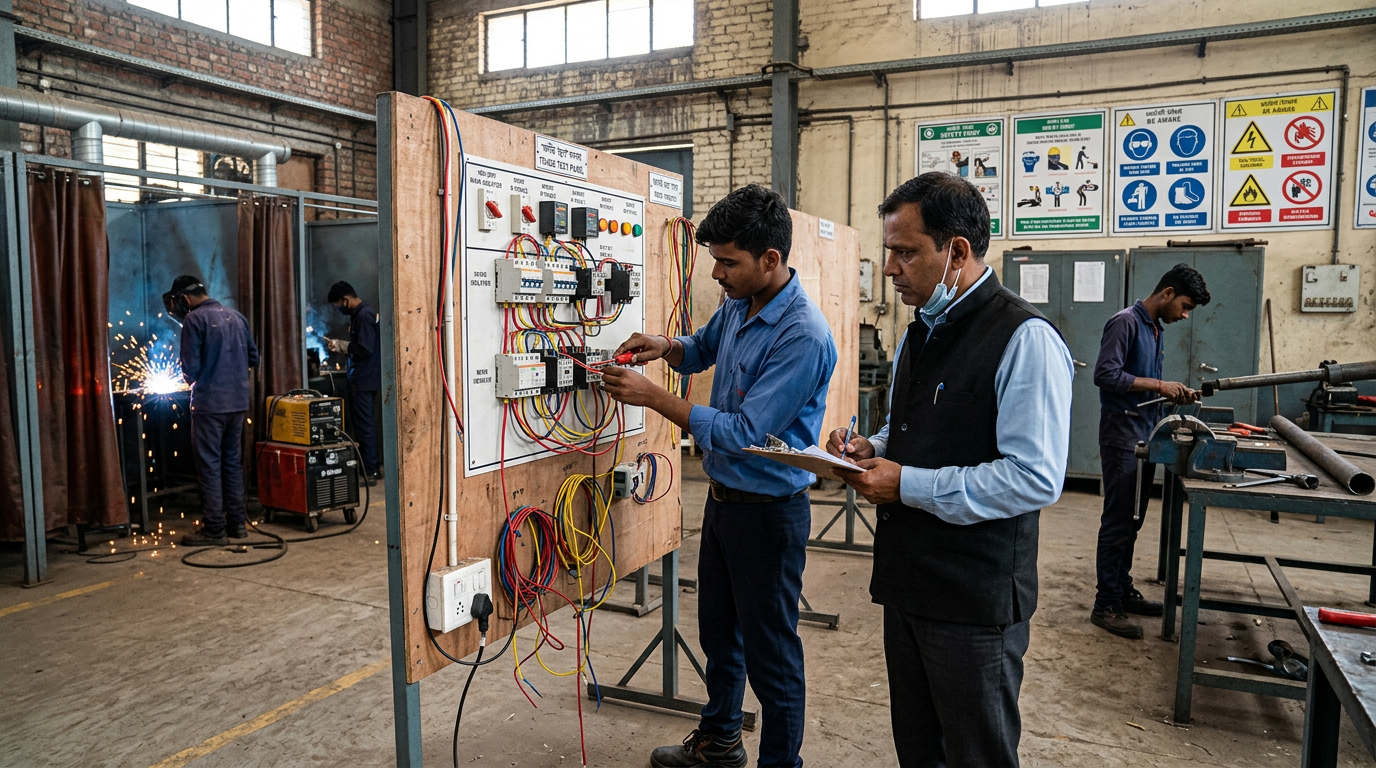
You do not need a training institute to run a basic screening. A small, safe workshop space is enough for most construction and MEP trades:
- Electrical – a wall board with DB, switches and sockets; megger and multimeter; a two-way lighting circuit task.
- Plumbing – PPR fusion kit and UPVC pipe with fittings; a small layout to follow; a pressure gauge for a simple test.
- Welding – a welding booth with extraction, plates and short pipe pieces; a basic visual and bend check on the coupon. For pipe welders, the real qualification is usually done to a code such as ASME Section IX, where a 6G pass covers all positions (MaterialWelding), and clients often insist on a third-party witnessed test. Your internal test is a filter, not a certificate.
- Masonry, carpentry, tiling – a corner to build a short block wall, a shuttering panel, a tile area with level and spacers.
- Drivers – a yard reversing test and a pre-trip vehicle check, if you have access to a vehicle and a safe area.
Keep the safety basics in place: PPE, a first-aid kit, fire extinguishers near hot work, and a person responsible for the test area.
A scoring sheet clients will trust
Use the same one-page sheet for every candidate in a trade:
- Candidate name, passport number, trade applied for, date, tester's name.
- Three to five practical tasks, each scored on a fixed scale with a short comment.
- Safety behaviour: PPE, tool handling, housekeeping.
- Theory questions: five or six short oral questions on materials, sizes and safety.
- Result: "Skilled", "Semi-skilled", "Helper level", or "Not suitable", with the tester's signature.
Photograph the finished work with the candidate's name card in the frame. When the client visits, you can show them the sheet and the photo for every candidate you shortlisted. That is evidence, not a promise.
Where the Saudi SVP fits
For Saudi Arabia, your internal test sits in front of an official one. The Skill Verification Program, run by the Saudi Ministry of Human Resources with Takamol, requires workers in listed trades to pass a theory and practical exam at approved centres before the work visa (Gulf News). India was the second country to join after Pakistan (Arab News), and in India the programme runs with NSDC. Guides on the 2026 rules describe a fee of around USD 50 and checks through Qiwa before visas are issued. The fee burden on workers has been criticised by migrant-rights groups (MRRORS), so be transparent about who pays and when.
Practical steps for your SVP workflow:
- Check the exact trade name on the visa and book the SVP in that same trade. A mismatch wastes a test.
- Run your internal test before the SVP, so candidates who are not ready do not pay an exam fee they will lose.
- Track results per candidate: booked date, centre, result, certificate number.
- Re-check the trade list and fee before each batch, because they change. Last checked: October 2026.
Recording results so the next batch is faster
Most agencies lose test results in WhatsApp chats and paper files. A simple digital record changes that:
- One profile per candidate with trade, test sheet, photos, SVP status and Wafid medical status.
- A filter by trade and level, so when a new demand letter for "Pipe Fitter – 6 positions" arrives, you already know who passed your test last month.
- Standard CVs for every candidate in the same format, so the client compares like with like.
Resume Arab's business tools let an agency collect candidate CVs in one Gulf-ready format through its own link; see CV software for Indian recruitment agencies and the business dashboard.
Honest communication with candidates
- Tell candidates the test result on the day, with the reason.
- Offer helper-level candidates the right vacancy instead of pushing them into a skilled slot they will fail.
- Never charge for a trade test "pass" or promise a client selection. For Indian ECR passports, emigration clearance only goes through eMigrate for registered agents (MEA), and every step should be documented.
A clean, honest testing record is also what protects the agency when a client or authority asks questions later.
How this connects to the demand letter
The trade test is the step between the demand letter and the client interview. If you are new to the paperwork side, read our guide on the Gulf demand letter and power of attorney: the trade names and numbers in that letter are exactly what your test bay should be set up to check.
FAQ
Should a recruitment agency run its own trade test?
Yes, if it can do so safely. A short internal practical test filters out candidates who will fail the client's or the official test, improves the selection rate on interview day and protects the agency's reputation with employers.
Is the agency's trade test the same as the Saudi SVP?
No. The internal test is a screening step. The SVP is the official Saudi exam at approved centres, and for listed trades the worker must pass it before the work visa.
Who pays for the SVP test?
Guides describe a fee of about USD 50. Whether the employer, agency or worker pays depends on the agreement, and migrant-rights groups have criticised workers carrying the cost, so make it clear in writing.
What records should an agency keep for each candidate?
The trade test sheet, photos of the work, SVP booking and result, Wafid medical status, passport details and a standard-format CV.