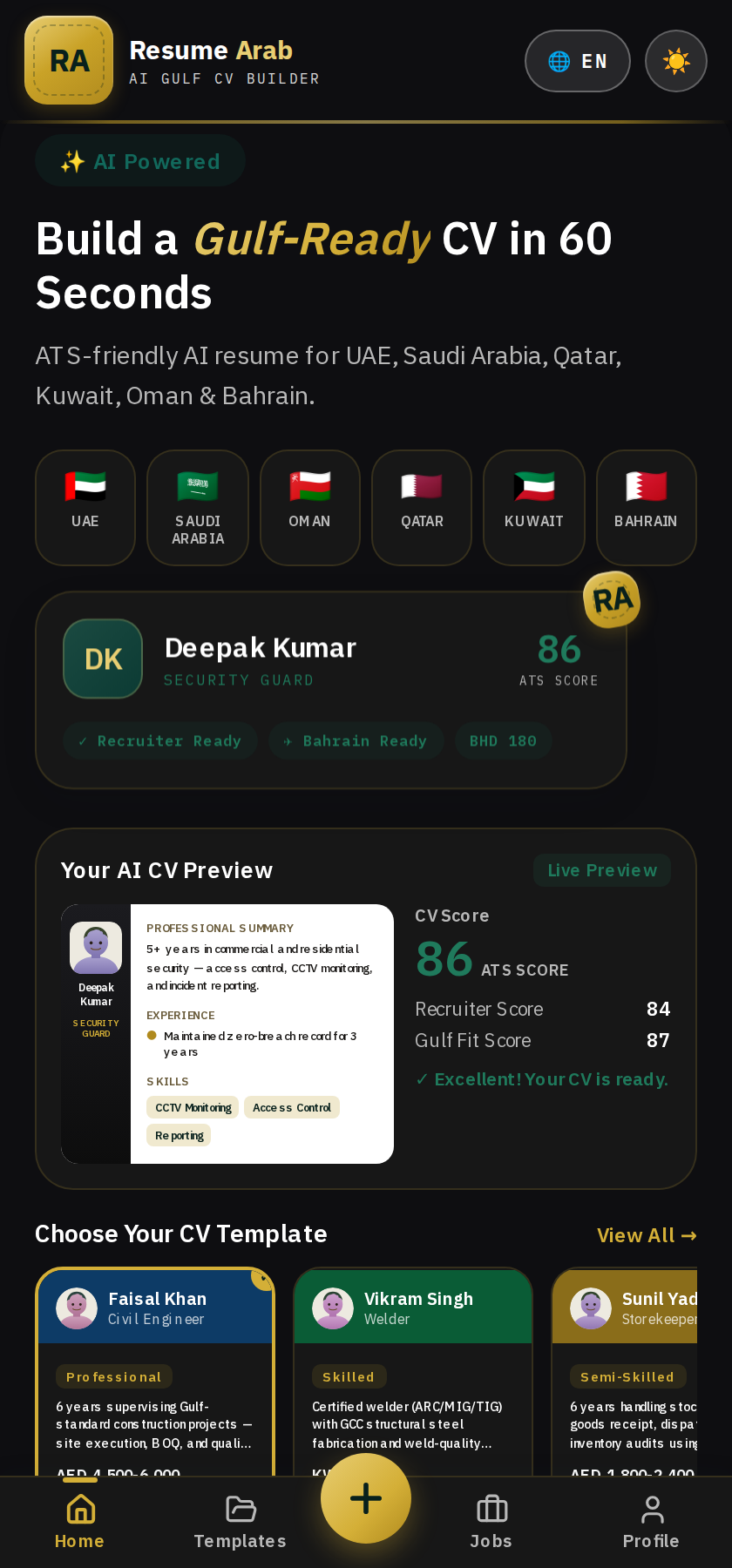
A Gulf CV is not the same as a CV for Europe or the US. Recruiters in Dubai, Riyadh or Doha expect details that a London employer would never ask for, such as your nationality, visa status and often a photo, because those details decide how you can be hired. A good template puts them in the right place so the recruiter finds them in seconds. This guide explains what a Gulf CV must include, how to choose between layouts, and how to keep your CV readable by the software (ATS) many employers use, before you open Resume Arab's free template gallery.
What every Gulf CV should show at the top
Most Gulf CV guides agree on a short personal-details block near the top. VisualCV's GCC CV guide and its UAE resume guide list items like these:
- Full name and job title (the trade or role you are applying for)
- Phone with country code and WhatsApp, plus email
- Nationality — it affects visa sponsorship and nationalisation quotas such as Emiratisation and Saudization
- Visa status — for example "Employment visa, transferable", "Visit visa until 30 June", or "In India, available to travel"
- Current location
- Date of birth and marital status — still common on Gulf CVs, though optional
- Driving licence — country and type, especially a UAE or GCC licence
For Saudi roles, VisualCV's Saudi CV guide adds that a professional photo is common but not mandatory, and that some employers like an Arabic version alongside the English one.
Should you add a photo?
In the Gulf, a professional passport-style photo is widely expected, usually at the top right. Use a plain background, collared shirt, neutral expression. If a job advert says "no photos", follow the advert. One caution from an ATS-focused UAE guide: some screening systems strip images or misread text placed around them, so keep the photo in its own space and never put important text inside an image.
Choosing a layout
The Resume Arab template gallery shows every design filled with a real sample CV, grouped by country theme (UAE, Saudi Arabia, Qatar, Oman, Kuwait, Bahrain) and by layout style:
- Classic: one column, simple headings. Best for trades, drivers and first-time jobseekers. Easiest for ATS software to read.
- Banner: a coloured header with your name, title and photo, then a clean single column. Good for hospitality, sales and customer-facing roles.
- Sidebar: a narrow side column for contact details and skills. Good for professionals with many certifications, as long as the main column carries your experience.
Country theming changes the accent colours, not the structure underneath, so you can match the country you are applying to without risking readability.
Build your Gulf-ready CV now — try it free, it only takes 60 seconds.
How to keep your CV ATS-friendly
Large Gulf employers and recruitment platforms often run CVs through screening software before a human reads them. To stay readable:
- Use standard headings: Summary, Experience, Education, Skills, Certifications.
- Put experience in reverse order, newest job first.
- Use the same words the job advert uses for your trade and tools.
- Avoid tables for your main experience and never put key text inside images.
- Save as PDF unless the employer asks for Word.
What to write in each section
Summary (2–3 lines): your trade, years of experience, strongest skill, and your availability. "Electrician with 6 years in residential and commercial fit-out, skilled in DB installation and fault finding. ECNR passport, available to join in 30 days."
Experience: for each job, the company type, country, dates, and 3–5 bullet points with numbers: "Installed lighting circuits for 120 apartments", "Maintained 40 split AC units per month".
Skills: tools, machines, software and safety training.
Education and certificates: ITI, diploma or degree, plus trade certificates with year.
Languages: list the ones you speak, including Hindi, Urdu, Malayalam, Arabic or English.
Templates by job type
Different jobs need different emphasis, even with the same template:
- Trades and technicians: put certificates and tools near the top, and keep it to one page if you have under five years of experience.
- Drivers: licence type, issue and expiry dates, vehicles driven and a clean record belong in the first half of page one.
- Hospitality and retail: a short summary that shows customer service, plus languages, matters most.
- Engineers and professionals: a two-page CV with projects, values and licences (such as Saudi Council of Engineers accreditation) is normal.
- Freshers: education, training, internships and part-time work, with a clear objective line.
Whatever the job, read the advert again before you send, and adjust the job title at the top to match it exactly.
Common template mistakes
- Choosing a flashy design with icons and charts that hide your actual experience.
- Leaving out nationality and visa status, which forces the recruiter to ask or skip you.
- Two different date formats in one CV.
- More than two pages for a trade job.
FAQs
How long should a Gulf CV be?
One page for most trades and junior roles, two pages for experienced professionals. Recruiters rarely read beyond that.
Are the templates free to preview?
Yes. You can browse and preview every template and country theme before building or paying.
Does a colourful template hurt my chances?
Not in our gallery; every layout keeps the same readable structure. Elsewhere, heavy graphics can confuse screening software.
Should my CV include my date of birth?
It is common in the Gulf but optional. Include it if the advert asks or if your target employers expect it.
Can I switch templates later?
Yes. Pick any template from the gallery and it opens in the builder with your details.
Pick a template and start
A clear Gulf-format CV shows the recruiter everything they need in the first ten seconds. Choose a layout, fill your details, and download it in minutes.
Build your CV with a Gulf template — free trial available.