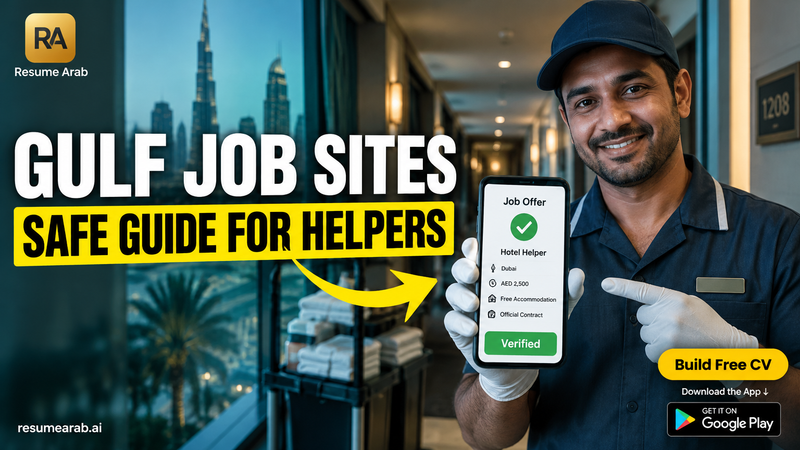
What "best Gulf job sites for unskilled helpers" really means
Most workers searching for the best Gulf job sites for unskilled helpers end up on big job boards that were built for engineers, accountants and IT staff. You scroll past hundreds of listings that need a degree, and the few helper, cleaner or labourer posts you do find give you no way to check if they are real. That is the gap I want to close here.
I am Salman. I have worked in GCC hiring for more than twelve years, on the agency side and inside company HR. I have seen helpers lose money to fake agents, fly out on the wrong visa, and arrive to find the salary was never what was promised. Almost none of that happened because the worker was lazy. It happened because nobody told them which sites are safe, which papers are checked at the airport, and which "offers" are traps.
So this guide does three things. It tells you which job sites are worth your time for helper-level work. It explains the official checks behind a genuine Gulf job — work permit, medical, emigration clearance, insurance. And it gives you the document list and the scam signals so you can tell a real offer from a fake one in under five minutes. If you want to start with a clean CV that agencies can actually read, Build your free Gulf CV in 2 minutes and come back to the checks below.
One thing before we go further. I will never tell you that applying for a Gulf job is free. There are real costs — passport, medical, insurance, sometimes a licensed agent's service charge. What you must never do is pay a large "visa deposit" to a stranger on WhatsApp before you have a signed contract and a verified employer. Keep that line in your head for the whole article.
The job sites that actually work for helpers, cleaners and labourers
Let me be blunt. The big Gulf job boards are not built for you, but they are not useless either. The trick is knowing what each one is good for and what it will never give you.
Bayt is the largest Gulf-focused board. It has country filters, industry filters and company pages, and you can upload a CV once and apply to many posts. For helpers, its weakness is that most listings are professional roles, and there is no guidance on visas or medicals. Use it to apply, not to learn the rules.
NaukriGulf works well if you already know the job title. Search "cleaner", "helper", "labourer", "housekeeping", "general worker" and set a country filter. It has job alerts, which matter for you — helper vacancies close fast because employers fill them in bulk. Set an alert and apply the same day.
GulfTalent is white-collar. Skip it for helper work unless a specific company you trust posts there.
GulfJobs.com is a plain listing site. It has country and category filters and lets employers post jobs directly. Treat every listing as unverified until you check the employer.
Indeed pulls listings from many sources. Its location and job-type filters are good, but it is not Gulf-specific legally, and it carries agency posts and scams mixed with real jobs. Never trust a listing just because it is on Indeed.
Resume Arab verified vacancies is the one I want you to look at seriously. It is a Gulf CV builder with a verified vacancies section, which means listings are checked before they go up. That does not replace your own checks, but it removes the worst noise. Browse Verified Gulf jobs alongside the boards above.
There are also company career pages — Aramex, Landmark, LuLu, big facility-management firms, hotel groups, cleaning contractors. These are the safest listings on the internet because the employer posts them itself. Search the company name plus "careers" and apply directly. It takes longer, but the rejection rate from scams is zero.
For salary expectations, do not trust what a WhatsApp agent tells you. Use a proper tool to compare what the same job pays across countries: Gulf salary check.
How to use filters so you stop wasting applications
Filters are the difference between ten good applications and two hundred wasted ones. Here is how I would set them for helper-level work.
Country filter. Pick one or two countries, not six. Each Gulf country has a different visa process, medical system and minimum wage. Applying to all six means you learn none of them properly.
Industry or category filter. Choose "hospitality", "facility management", "construction", "domestic work" or "logistics". These are where helper, cleaner and labourer jobs sit. Avoid "general" categories — they are full of agency spam.
Company filter. On Bayt and GulfJobs.com you can look at a company page. Check how long the company has existed, whether it has a real website, and whether it posts the same job repeatedly. A company that reposts the same helper job every week for months is usually collecting CVs, not hiring.
Location filter. Inside a country, filter by city. A Dubai listing and a Sharjah listing can mean very different commutes and accommodation. If the employer provides housing, ask where it is before you sign.
Job type filter. Set it to full-time and contract. Avoid "part-time" and "temporary" unless you are already in the Gulf with a valid visa — these are usually for people already inside the country.
Remote jobs. Ignore them for helper work. Remote listings on Gulf boards are almost all professional roles, and a "remote helper job" is a classic scam phrase. There is no such thing.
Job alerts. Turn them on for your exact job title and country. Helper vacancies fill in days, sometimes hours, because employers hire in groups. An alert means you are in the first fifty applicants instead of the five-hundredth.
CV upload and registration. Register once with a complete profile on two or three sites, not ten. A half-filled profile gets ignored. Upload a clean one-page CV and keep the same version everywhere so you can track which site produced a call.
Resume services. Paid CV writing is usually a waste of money for helper roles. Employers want a short, clear CV with your duties, your experience and your passport status. You can build that yourself.
What employers and trade tests actually check
Here is what I look at when a helper CV lands on my desk, and what a trade test really involves.
The CV. One page. Name, phone with country code, passport nationality, current location, languages, then work history with bullet points that describe duties. Not "hardworking and honest". Instead: "Cleaned 40 hotel rooms per shift to brand standard", "Loaded and unloaded 20-foot containers", "Operated floor scrubber and buffing machine". Numbers and tools tell me more than adjectives.
The interview. Short and practical. Can you follow safety instructions? Do you understand basic English or Arabic for the job? Are you physically able to do the shift? Will you accept the accommodation and the contract length? Answer honestly. A helper who says "yes" to everything and then refuses the contract after arrival costs the employer a visa and a flight.
The trade test. For cleaners, housekeepers and general labourers, the test is usually simple: demonstrate mopping, dusting, bed-making, waste handling, or safe lifting. For construction helpers, it may be carrying, mixing, or using basic tools under supervision. For kitchen helpers, it is washing, peeling and hygiene. What they check is not speed. It is whether you understand safety, hygiene and instructions. If an agent asks you to pay for a "trade test certificate" from a private company before any employer has interviewed you, walk away.
Documents the employer verifies. Passport validity (usually at least six months), clean medical, no fake experience letters, and a work permit tied to that employer. In the UAE, a private-sector worker needs a MOHRE-issued work permit before starting work, and that permit is employer-specific — MOHRE work permit. The UAE private-sector labour law is Federal Decree-Law No. 33 of 2021, in force since 2 February 2022 — UAE labour law. In Saudi Arabia, the employment contract is documented through the Qiwa platform — Qiwa. If an agent cannot tell you which platform your contract will be registered on, that is a warning.
The official checks: medical, emigration and insurance
This is the part the big job boards skip, and it is the part that decides whether you actually board the flight.
Medical tests. For GCC employment, GAMCA medical certificates are valid for 3 months — GAMCA. For Saudi-bound workers, Wafid tests are valid for 90 days from the examination date — Wafid. That means you do not do the medical months in advance. You do it when the employer is ready to process the visa, because an expired certificate means paying twice.
Indian ECR clearance. If you hold an Indian passport with ECR status, you need emigration clearance for employment in 18 ECR countries, including UAE, Saudi Arabia, Qatar, Kuwait, Bahrain and Oman — eMigrate. This is not optional and it is not something an agent can "arrange later". Check your passport for the ECR stamp before you accept anything.
Insurance. India's Pravasi Bharatiya Bima Yojana (PBBY) is mandatory for ECR emigrants and gives ₹10 lakh insurance cover — PBBY. In the UAE, from 1 January 2023, private-sector employees must be registered in the ILOE unemployment insurance scheme, and the fine for non-compliance is AED 400 — ILOE. Ask the employer who registers you and get it in writing.
Minimum wage reality. Qatar's minimum wage is QR 1,000 per month, plus QR 500 for accommodation and QR 300 for food if the employer does not provide them; the rule took effect on 20 March 2021 — Qatar minimum wage. Other Gulf countries set wages by contract and market, not a single national figure, so compare the full package — salary, housing, food, transport, overtime — not just the headline number.
Use a proper checklist before you sign anything: Visa checklist. It walks you through the papers in order.
Scam signals: how to spot a fake Gulf job in five minutes
I have heard every version of this. Here is what should make you stop.
- Money before contract. A genuine employer does not ask you to send a "visa deposit", "processing fee" or "security amount" to a personal account before you have a signed contract. Licensed agents charge a service fee, and it is documented. Cash to a mobile number is not.
- No company name. If the agent will not tell you the employer's name, or gives a name you cannot find anywhere, stop.
- WhatsApp-only contact. Real employers have an office, an email domain and a landline. A recruiter who only uses a personal WhatsApp number and refuses a video call is a risk.
- Salary too high for the job. If a cleaner job offers far more than the market rate for that country, it is bait. Check the market rate first with Gulf salary check.
- Pressure to fly fast. "Visa expires tomorrow, pay now." Real hiring has a process. Urgency is a tool.
- No trade test, no interview. If nobody has asked you a single question about your work, they are not hiring you. They are selling you something.
- Asking for your passport to "keep safe". Never hand your passport to an agent. Employers may hold it during visa processing under local rules, but an agent before contract should not.
- Free visa claims. A "free visa" where you pay later, or work for a different employer than the one on your permit, is illegal in the Gulf and puts you at risk of fines and deportation. Your work permit is tied to one employer.
If any two of these appear together, walk away. There is no shortage of real jobs. There is a shortage of workers who check.
Documents to prepare before you apply
Get these ready as clear scans on your phone. It speeds up everything.
- Passport, valid at least six months, with the ECR/non-ECR page visible.
- Passport-size photos on white background.
- A one-page CV with duties in bullet points.
- Experience letters from previous employers, if you have them. Do not fake them — employers verify.
- Educational certificates, even if basic. Some visas require them.
- Police clearance certificate, if the employer asks.
- Medical fitness certificate from an approved centre (GAMCA or Wafid, depending on destination).
- For Indian ECR holders, emigration clearance through eMigrate and PBBY insurance.
- Signed employment contract showing salary, accommodation, food, transport, working hours, overtime and contract length.
Keep a folder on your phone and a printed set. When an employer asks, you send in minutes, not days. That alone puts you ahead of most applicants.
Country notes for UAE, Saudi Arabia and Qatar
UAE. Work permit through MOHRE, contract under Federal Decree-Law No. 33 of 2021, ILOE registration for private-sector employees. Ask for the offer letter and the MOHRE permit before you fly.
Saudi Arabia. Contract documented on Qiwa. Medical through Wafid, valid 90 days. Check the sponsor name on the visa matches the contract.
Qatar. Minimum wage QR 1,000 plus allowances as above. Confirm accommodation and food in the contract, because the allowance structure changes your real take-home.
Kuwait, Bahrain, Oman. Rules differ on medical centres and contract registration. Ask the employer which platform your contract will be registered on, and check it yourself.
Wherever you go, the pattern is the same: verified employer, written contract, official medical, legal emigration route, insurance in place.
FAQ
What are the best Gulf job sites for unskilled helpers?
Use a mix. Bayt and NaukriGulf for volume and job alerts, company career pages for safety, and Verified Gulf jobs on Resume Arab for checked listings. Skip white-collar boards like GulfTalent for helper roles. No single site is enough — apply on two or three and verify every employer yourself.
Which Gulf country pays helpers the most?
There is no single answer, because pay depends on the employer, the role and the full package — salary, housing, food and overtime. Qatar has a published minimum wage of QR 1,000 plus allowances — Qatar minimum wage. Compare total packages, not headline salaries, using Gulf salary check.
Do helper jobs in the Gulf require a medical test?
Yes. GAMCA certificates are valid for 3 months — GAMCA — and Saudi Wafid tests are valid for 90 days — Wafid. Do the medical only when the employer is ready to process your visa, so it does not expire before travel.
How can Indian helpers get a Gulf job legally?
Check your passport for ECR status. ECR holders need emigration clearance for 18 ECR countries including UAE, Saudi Arabia, Qatar, Kuwait, Bahrain and Oman — eMigrate — and PBBY insurance is mandatory, giving ₹10 lakh cover — PBBY. Use a licensed agent or apply directly, and never pay a deposit before a signed contract.
What documents are needed for a helper visa in UAE, Saudi Arabia or Qatar?
Passport valid at least six months, photos, CV, experience letters, medical certificate, signed contract, and for Indian ECR holders emigration clearance and PBBY. In the UAE, the employer must obtain a MOHRE work permit before you start — MOHRE work permit. In Saudi Arabia, the contract is documented on Qiwa. Run through the full Visa checklist.
Is a trade test required for Gulf helper jobs?
Often yes, especially for cleaners, housekeeping, kitchen helpers and construction labourers. The test checks safety, hygiene and whether you follow instructions — not speed. A genuine employer or licensed agent arranges it. If a private company demands payment for a "trade test certificate" before any employer interview, treat it as a scam signal.
How much salary does a helper get in the Gulf?
It varies by country, employer and package. Qatar's published minimum is QR 1,000 per month plus QR 500 accommodation and QR 300 food if not provided — Qatar minimum wage. Always compare the full package including housing, food, transport and overtime. Do not rely on what an agent tells you.
Are Gulf job sites free for helpers?
Applying for a Gulf job is not free. Passport, medical, insurance and sometimes a licensed agent's documented service fee all cost money. What you must never do is pay a large deposit to a personal account before a signed contract. Use Build your free Gulf CV in 2 minutes to keep the CV side at zero cost, and spend only on official documents.
How do I avoid Gulf job scams?
Check five things: the employer's real name and website, a signed contract before any payment, no cash to personal accounts, a proper interview or trade test, and official medical and emigration papers. If an offer is rushed, vague or too well paid, walk away. Verify the employer independently and use Verified Gulf jobs as one safe starting point.
Final word from Salman
The best Gulf job sites for helpers are the ones used with care: two or three job boards, company career pages, verified listings and official sources for every legal step, plus a clear one-page CV.
The best Gulf job sites for unskilled helpers are not the ones with the most listings. They are the ones you use with a clear head: two or three boards for reach, company career pages for safety, verified listings for a filter, and official sources for every legal step. Your CV should be one page of real duties. Your documents should be ready before you apply. Your contract should be signed before any money moves. Do those three things and you remove most of the risk that catches other workers.
Keep this page open while you apply. Check the medical validity, the emigration route and the insurance before you book anything. And when you are ready, Download the Resume Arab app to keep your CV and checks in one place, then Build your free Gulf CV in 2 minutes and start applying the safe way.